Look back at any BTC chart and you'll notice something odd: price seems to hesitate at $30,000, $50,000, $100,000 — clean, round numbers — far more often than it stalls at $47,312 or $89,650. That's not a coincidence, and it's not magic either.
It starts with where people actually place orders
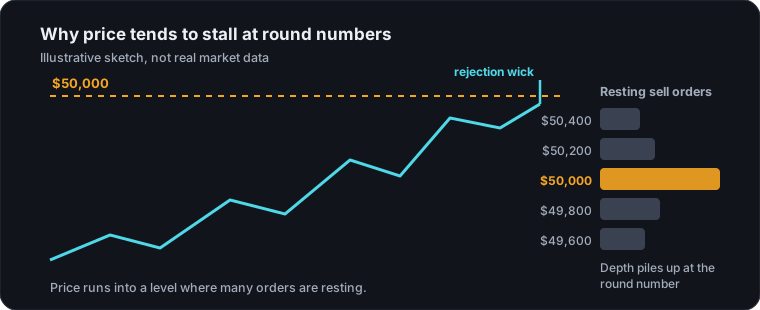
Most traders set limit orders, stop-losses, and take-profits at round numbers because they're easy to remember and easy to type. Nobody sets a buy order at $42,187.43. They set it at $42,000 or $42,500. When thousands of independent traders round their orders the same way, those levels accumulate real, visible liquidity in the order book — which is exactly what CryptoBolt's order book depth view is showing you.
Why that turns into an actual price reaction
A cluster of resting orders at a round number acts like a wall: buy orders pile up as support, sell orders pile up as resistance. Price arriving at that level has to absorb all of that liquidity before it can keep moving, which is what produces the pause, the wick, or the rejection candle you see on the chart. It's a self-fulfilling pattern — round numbers matter *because* enough people believe round numbers matter and trade accordingly.
The catch
This isn't a standalone signal. A round number with high volume and heavy order book depth behind it is meaningfully different from a round number with a thin book — the level matters because of the liquidity sitting there, not because of the number itself. Treat it as one more piece of context, the same way you'd weigh Fear & Greed or funding rate: informative on its own, more useful stacked with everything else.
How to check it in practice
- Order book: is there visible size sitting at the level, or is the book thin around it?
- Volume: is activity rising as price approaches, or fading?
- Timeframe: does the level stand out on the daily chart, or only on a one-minute chart where it means little?
Where to go next
- Reading the Fear & Greed index: sentiment context to stack with levels.
- Crypto funding rates explained: whether the crowd is leaning one way as price reaches the level.
- Bitcoin live price: live BTC/USDT to watch these levels in real time.
- Glossary: support and resistance, order book depth, wick and more.