"$1000 in one day." It's not a coincidence that this exact phrasing shows up everywhere — YouTube thumbnails, X threads, "signal group" ads, screenshotted trading apps. It's a specific, tested formula, and it works on smart, careful people, not just beginners. Understanding why it works is more useful than being told not to fall for it.
What's actually in that headline
Three things are doing the work, and none of them are accidental:
- A round number. $1000 is memorable and psychologically "achievable-sounding" in a way that $847 or $1,240 isn't — round numbers read as goals, not data.
- A single day. Compressing the timeframe makes the outcome feel close and repeatable — "$1000 a day" implies $30,000 a month, without anyone having to say that number out loud and trigger your skepticism.
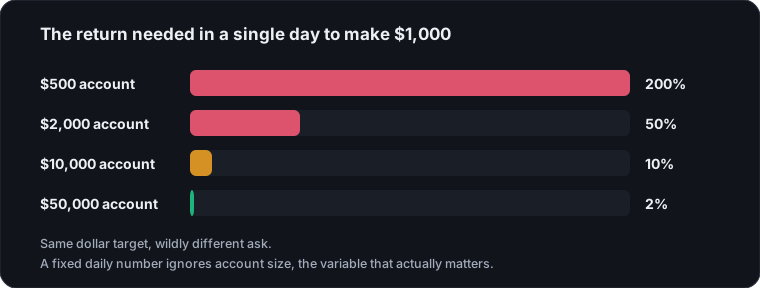
- An implied "you too." The headline never says how much capital, leverage, or luck was involved. That's the gap your imagination fills in with your own account size, which is exactly what makes it feel personally achievable.
Why your brain responds to it anyway
- Variable-ratio reward, same as a slot machine. Trading (and headlines about trading wins) deliver payoffs on an unpredictable schedule. That's the single most addictive reinforcement pattern known in behavioral psychology — more compelling than a reward you can count on, because you never know which attempt pays off.
- Survivorship bias, presented as a typical result. For every screenshot of a $1000 day, there are (per the research on actual day trader outcomes) dozens of accounts that lost money quietly and never posted about it. You're being shown the tail of the distribution and asked to treat it as the middle.
- FOMO plus social proof. Seeing someone else's win triggers a fear of being the one who didn't act — and a screenshot from a stranger functions the same way a crowded restaurant does: if others are doing it, it must be safe and smart.
- Anchoring on the upside, not the downside. The headline shows the $1000 win. It doesn't show the leverage or position size required to make that plausible on a small account — or the equally-sized loss that's sitting on the other side of the same trade.
Who's actually profiting from the headline
This is the part that matters most: in most cases, the person posting "$1000 in a day" doesn't make money from the trade — they make money from you clicking.
- Affiliate and referral links to exchanges pay the poster per signup, regardless of whether you ever profit.
- Paid "signal" or "VIP" groups charge a subscription up front — their business model works whether or not the calls are any good, because the money is made at signup, not from your trading results.
- Pump-and-dump coordination sometimes uses exactly this framing to recruit late buyers into a thinly-traded coin, with the "$1000 in a day" screenshot coming from the organizers who bought in before the post went out.
- Course and mentorship sellers use the same screenshots as a funnel into a paid product — the trading result is the advertisement, not the actual business.
None of this requires malice from every single poster — some genuinely had a lucky day and are honestly (if misleadingly) sharing it. But the format itself is optimized by trial and error across thousands of creators to convert attention into clicks and signups, whether or not the underlying claim holds up.
Five questions to ask of any "I made $X" post
- What was the account size, and so what was the percentage return?
- How much leverage was used, and what was the position size?
- Is there a record of the losing trades too, not only the best day?
- Does the poster earn from referrals, subscriptions, or courses?
- Can the result be repeated, or is it one trade?
What to do with that instead
The useful question was never "how do I get the $1000." It's "what would it actually take, and is that a real, repeatable plan or a single lucky outcome being presented as one." We wrote up what the actual long-run research on day trading returns shows — it's a very different picture than any single screenshot.
If you want to test a strategy against real conditions without the affiliate link, the subscription fee, or the actual risk, CryptoBolt's paper trading simulator runs on live market data with no signup funnel attached to the result either way.
Related reading: why CryptoBolt doesn't predict crypto prices covers the same trap from the forecasting side, and spot vs. perpetual futures explains the leverage mechanics behind many of these screenshots. Unfamiliar term? Check the glossary.